The Gas Takes a Return Trip. The Bill Stays Here.
Australia is the world's third-largest LNG exporter — and it's about to start importing LNG.
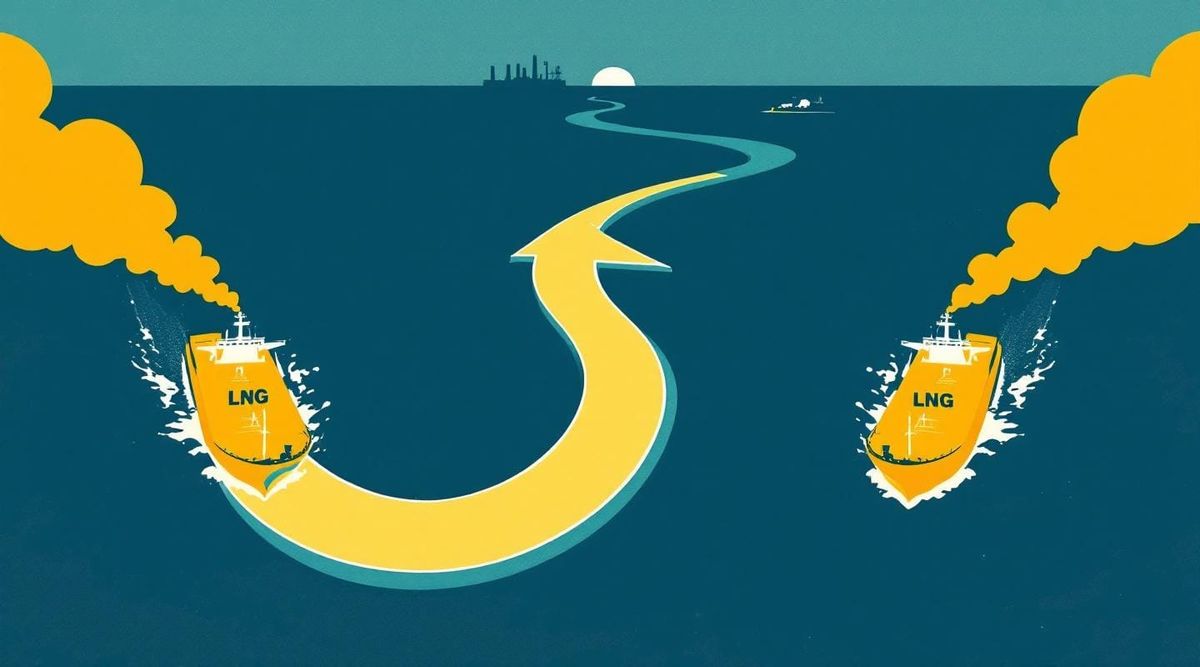
The same molecule leaves Curtis Island in Queensland on a tanker bound for Osaka, sells at world prices, and a different tanker carries world-priced LNG back into Geelong for winter. The gas takes a return trip. The bill stays here.
Australia ships about a fifth of all the LNG sold on Earth, behind only the United States and Qatar. On 1 April this year, federal regulators ticked off a terminal at Geelong to start importing it back. Not an April Fool's gag — the present tense.
The lock-in came first. Queensland's three Curtis Island LNG plants were sanctioned in 2010–11 and started shipping in 2015, on twenty-year contracts to buyers in Tokyo, Seoul and Shanghai. About 80 per cent of the gas Australia produces goes overseas. Those contracts were signed in good faith, before any domestic-reservation mechanism existed; tearing them up unilaterally would torch the trade relations a third-largest exporter depends on. Which is why the new reservation scheme Canberra is wiring up for 2027 only bites on new contracts. Fair enough. Also: cold comfort to a Geelong household in July, sitting in three jumpers watching the gas meter tick like a broken pokies machine.
Then the squeeze. Bass Strait is in genteel decline. Victoria's fracking ban is bolted into the state constitution — driven less by ideology than by farmers, water-table scientists and Traditional Owners who wanted no part of it — and the conventional onshore restart since July 2021 has produced more press releases than gas. In NSW, Santos's Narrabri project is still grinding through litigation. The ACCC's latest warning is concrete: chair Gina Cass-Gottlieb says the southern states face a "supply gap of 16 PJ in July 2026 alone". East-coast wholesale prices have roughly tripled since exports began, by IEEFA's reckoning.
The missing wire. There is no economic pipeline running WA's North West Shelf to the southeast. AEMO's 2025 GSOO is upfront that the country runs two separate gas markets — one well-supplied and pointed at Asia, one declining and pointed at Melbourne. Distances are vast, terrain is hard, and successive feasibility studies have come back uneconomic. So policymakers aren't dim — they're trapped between commercial reality and the fact the front door was already monetised.
Both major parties wear this. The Curtis Island deals were Coalition-era; the Future Gas Strategy committing the country to gas "through to 2050 and beyond" is Labor's. The gas trigger — Canberra's theoretical power to claw export gas back for domestic use — has never been pulled under either.
Two gas markets. Two parties. One molecule taking the long way home.