Year 7 Maths: The Net Zero Exam Nobody in Canberra Can Pass
Show your working, Canberra
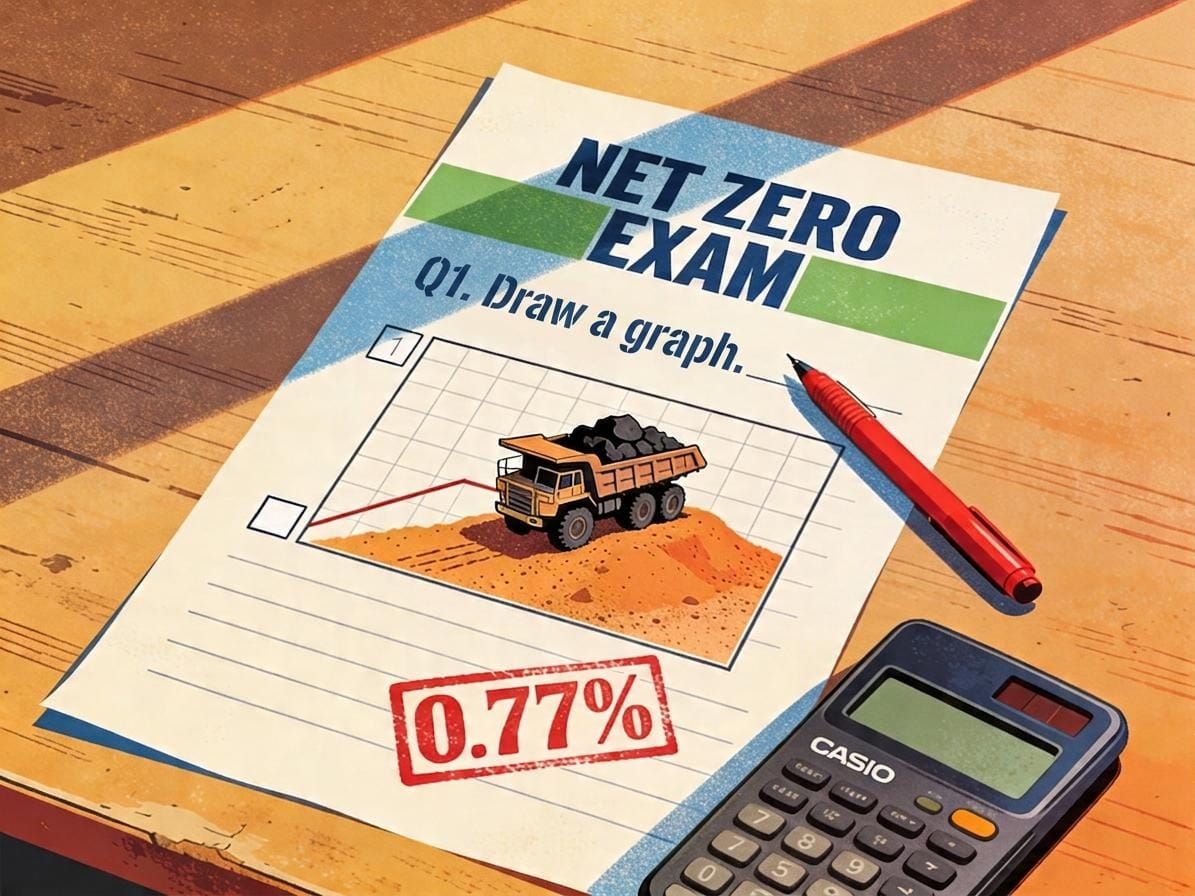
In Year 7 maths, they teach you to show your working. Below is a four-question exam on Australia's net zero policy. You will need a calculator and a strong stomach. Calculators are provided. Stomachs are your own problem.
QUESTION 1: The Counterfactual (5 marks)
Australia's annual greenhouse gas emissions are 446.4 Mt CO2-e (2024). Global greenhouse gas emissions hit 57,700 Mt CO2-e in the same year — an all-time record.
(a) Express Australia's share as a percentage of global emissions. Show your working. (2 marks)
(b) The graph below shows the global greenhouse gas emissions trend line. Plot a second line showing global emissions without Australia's contribution. (2 marks)
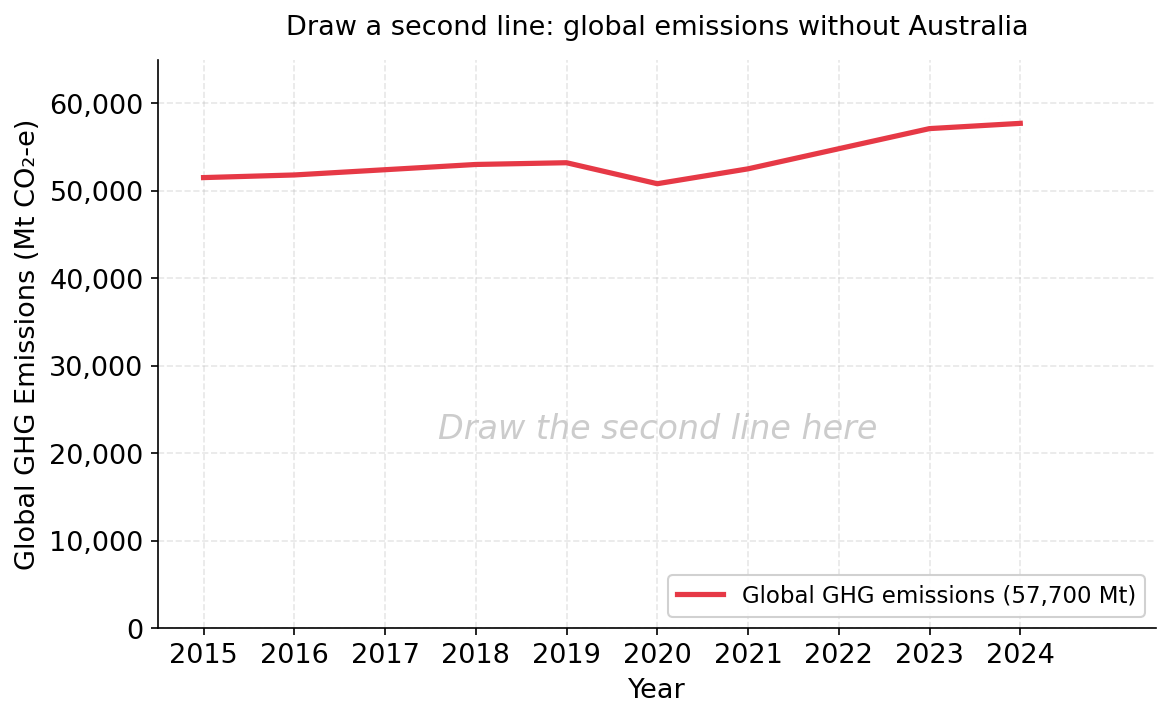
(c) Can you tell the lines apart? (1 mark for honesty.)
For scale: China emits ~16,000 Mt CO2-e per year.2 That is Australia's entire annual output, every 10 days.
QUESTION 2: The Export Problem (8 marks)
(a) Australia exported 356 million tonnes of coal in 2024 — to Japan, China, India and others. Each tonne of coal produces approximately 2.4 tonnes of CO2 when burned. Calculate the CO2 generated when Australia's coal exports are burned overseas. (2 marks)
(b) Australia also exported 81 million tonnes of LNG in 2024, making it the world's second-largest LNG exporter. Each tonne of LNG produces approximately 2.75 tonnes of CO2 when burned. Calculate the CO2 generated when Australia's LNG exports are burned overseas. (2 marks)
(c) Now add Australia's domestic emissions (446.4 Mt CO2-e) to your answers from (a) and (b). What is Australia's total greenhouse gas footprint? (2 marks)
(d) Despite $9 billion a year in federal climate spending, domestic emissions rose 13.5 Mt from 2023 to 2024 — partly post-COVID recovery, partly lower hydro forcing more fossil fuel generation. Express this increase as a percentage of your answer to (c). (2 marks)
QUESTION 3: The Revenue Hole (4 marks)
If we stop exporting fossil fuels to stay consistent with our climate commitments, the combined federal and state revenue hole from coal is approximately $15 billion per year — roughly $6-7 billion in federal company tax plus $5.5 billion in Queensland royalties and $3 billion from NSW. Add LNG and gas: $1.5 billion in PRRT, $2.4 billion in Queensland petroleum royalties, and $650 million in WA gas royalties. That is roughly $20 billion per year.
(a) Multiple choice. Which of the following do you cut to fill it? (2 marks)
(a) All foreign aid ($5.1 billion), the ABC ($1.2 billion) and SBS ($360 million) — and you're still $13.3 billion short
(b) Half of Queensland's entire education budget — tell the kids it's for the climate
(c) Sixteen ABCs
(d) All of the above, and you're still short
QUESTION 4: The Bill for a 20-Year-Old (5 marks)
A 20-year-old in their first full-time job earns roughly $55,000. After the tax-free threshold, LITO, and Medicare, they pay about $8,038 in tax.
(a) Using your answer to Question 3(b), and approximately 14 million individual taxpayers, calculate the per-taxpayer share. (2 marks)
(b) Express the 20-year-old's pro-rata share against their $8,038 tax bill as a percentage, then convert to working days per year. Assume a net daily wage of ~$181. (2 marks)
(c) From Question 2(c), Australia's total greenhouse gas footprint — domestic emissions plus coal and LNG exports — is approximately 1,524 Mt CO2-e. Express this as a percentage of global emissions (57,700 Mt). Are you happy to work that many days a year to achieve that reduction? (1 mark for honesty.)
END OF EXAM
Please put your pens down and turn to the answers section.
ANSWERS
QUESTION 1
(a) 446.4 / 57,700 = 0.77%.1
(b)
Global emissions with Australia: 57,700 Mt. Without: 57,254 Mt.
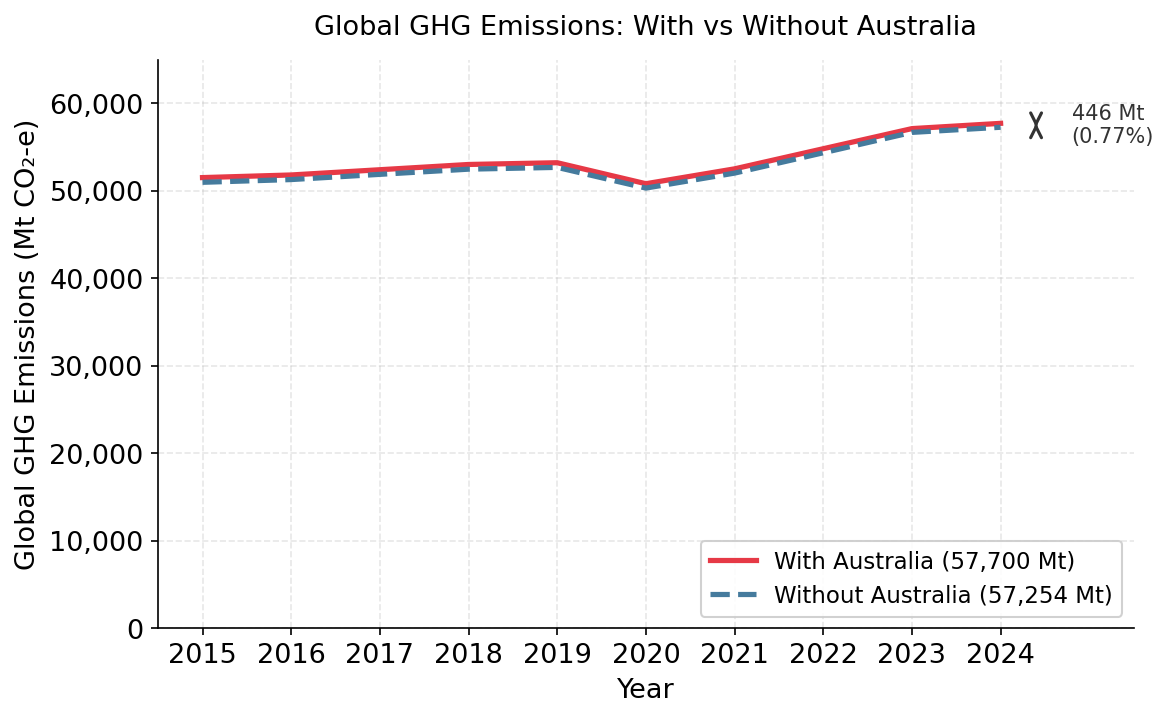
(c) No. You cannot. (1 mark.)
QUESTION 2
(a) 356 Mt x 2.4 = ~855 Mt CO2.
(b) 81 Mt x 2.75 = ~223 Mt CO2.
(c) 855 + 223 + 446.4 = ~1,524 Mt CO2-e. Australia's total greenhouse gas footprint is more than three times its domestic emissions. Climate Analytics puts the total even higher at ~1,600 Mt when oil exports are included.
(d) 13.5 / 1,524 = 0.89%. Not only did we not reduce our total footprint — we increased it. By less than one percent.
QUESTION 3
(a) There is no correct answer. That is the point. Option (a) totals $6.66 billion — you are still $13.3 billion short.
QUESTION 4
(a) $29 billion / 14 million = ~$2,071 per taxpayer per year.
(b) $2,071 / $8,038 = ~26%. On a net daily wage of ~$181, that is approximately 11.4 working days per year — more than two full working weeks — for a problem where Australia's domestic emissions are 0.77% of the global total.
(c) 1,524 / 57,700 = 2.64%. That is the absolute maximum reduction in global emissions if Australia shut every mine, capped every gas well, killed every cow, and eliminated every domestic emission overnight. 11.4 working days per year for 2.64%. Meanwhile, China will add Australia's entire annual domestic emissions to its own total in the next 10 days. (1 mark for any honest answer.)
A 12-year-old with a Casio could do this arithmetic. The numbers are not hidden — they sit in budget papers, quarterly reports, and emissions inventories that anyone can Google. Whether Australia should spend hundreds of billions to address 0.77% of a global problem while exporting the fuel for three times that — genuinely hard. The maths is not. Show your working, Canberra.
The writers' room: Research by Deep Dive Dave. Drafted by The Drafter. Rhythm by Lyra Lilt. Cut by The Trimmer. Humour by The Galah.
- You may see Australia's share quoted as ~1.1% elsewhere. That figure uses CO2-only emissions (IEA: 37,800 Mt). This exam uses total greenhouse gas emissions in CO2-equivalent (UNEP: 57,700 Mt), which includes methane, nitrous oxide, and fluorinated gases. Both figures are legitimate. The 0.77% is the more complete measure. The argument holds either way. ↩
- China's total GHG emissions are approximately 16,000 Mt CO2-e per the EDGAR database (15,944 Mt CO2-e excluding LULUCF, 2023) and consistent with the UNEP Emissions Gap Report 2024, which attributes ~30% of global emissions to China. ↩