Free Sun, Expensive Poles
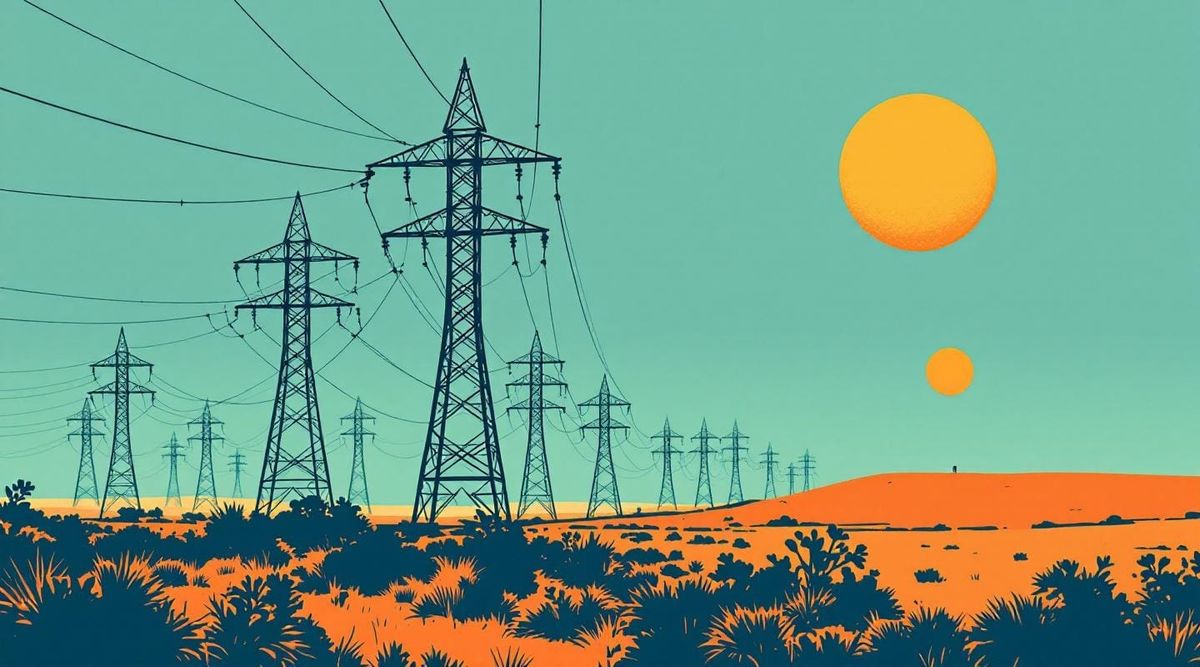
The sun, famously, sends no invoice. The wires that carry its electrons very much do.
For a decade the political class has been selling Australians on "the cheapest form of new generation in history," which on a marginal-cost basis is true: Grattan keeps showing the working, and the working is sound. The bit they leave off the bumper sticker is that zero-marginal-cost electrons are useless until you build something to carry them: steel, copper, easements, forty years of bill-payer recovery. Politicians cost the electrons. Engineers cost the wires. Guess which number makes the talking points.
Coal was big and dumb. Dumb was cheap to wire.
Coal had one virtue its marketing department never had to explain: it sat next to the load. A 2–3 GW slab in the Hunter, the La Trobe Valley, or near Gladstone ran 60–85% of the time, spun synchronously, and threw inertia in for free. The transmission grid grew up around it by inheritance: short, fat, well-utilised lines from generator to city.
Wind and sun do not work like this. They turn up where the weather is, mostly nowhere near anyone. The new grid has to chase them across the continent with copper, sized for the peak and used a quarter to half the time. Per megawatt-hour delivered, you need more line.
The arithmetic, with receipts
AEMO's 2024 Integrated System Plan commits to roughly 5,000 km of new and upgraded transmission this decade and 10,000 km by 2050, on top of an existing ~40,000 km HV network. That is about an eighth of the high-voltage backbone, rebuilt in ten years, to chase paddocks of wind turbines.
The price tag has not aged gracefully. Nor has anyone's face when they explain it. Total expected transmission spend has nearly tripled since the 2020 ISP, from about $30 billion to $65–85 billion. VNI West doubled to $7 billion in eighteen months. Project EnergyConnect's NSW leg doubled to $3.6 billion. CopperString 2032 (one line, Townsville to Mt Isa) went from $1.8 billion to $13.6 billion. That's 7.5 times over. Then they quietly carved it in half. HumeLink finished its regulatory test around 2020–21; main works began late 2025, with completion now aimed at late 2027. Six to seven years from RIT-T to first electrons, if those dates hold. None of these are scandals. They are what building 5,000 km of high-voltage line through someone's back paddock costs in 2026.
Who pays? You do, three ways. First, the Transmission Use of System charge: generators don't pay TUOS, households do, indefinitely, on every kilometre of regulated asset base. Second, the $19.65 billion Rewiring the Nation fund, of which more than half is already committed to HumeLink, Marinus, VNI West and the Central-West Orana zone: concessional debt, repaid by you the taxpayer for being patient. Third, the Commonwealth bought 49% of Marinus Link outright, Victoria and Tasmania covering most of the rest. The Commonwealth is now an electricity transmission company. This was not in the original job description.
The AEMC's December 2025 price trends report puts the punchline up front: bills fall about 5% over the next five years, then rise about 13% in the five after that as wholesale supply lags demand. Delays to renewables and transmission are a named upside risk. Build on time and near-term relief lasts longer; miss and the later climb steepens. That's not a choice. That's a tab.
The sun is free. The poles are $65–85 billion. Anyone selling you the first number without the second is doing marketing, not arithmetic.